6 Signs It’s Time to Replace Your HVAC System (2026 Update)
Is your furnace ready for another London winter? Or is your air conditioner struggling to keep up with the humid Ontario summer?
Your HVAC system is the unsung hero of your home. It works tirelessly day and night to keep your family comfortable, but like any mechanical system, it has a finite lifespan. Knowing exactly when to stop paying for repairs and invest in a replacement is one of the toughest decisions homeowners face.
At My Fireplace, we believe in helping you make informed financial decisions. Sometimes, a simple repair is all you need. But other times, throwing money at an aging system is a bad investment. In this guide, we’ll break down the six critical signs that it’s time to retire your old unit, along with the latest 2026 rebate information to help you save thousands on an upgrade.
Key Points Summary
Age Matters: Gas furnaces typically last 15–20 years, while air conditioners last 10–15 years.
The Math of Replacement: Use the $5,000 Rule (Age x Repair Cost) or the 50% Rule (Repair > 50% of new unit cost) to decide if a repair is worth it.
Rising Bills: Spiking energy costs often indicate efficiency drift; modern Energy Star units can lower bills by up to 30%.
Comfort Signals: Hot/cold spots, humidity issues, and strange noises (banging, squealing) are clear signs of mechanical failure.
Safety First: Cracked heat exchangers can leak deadly Carbon Monoxide (CO); if your unit is "red-tagged," replacement is mandatory.
2026 Incentives: New rebates from the Home Renovation Savings Program (HRS) and Save on Energy make 2026 an ideal year to upgrade to a high-efficiency heat pump or furnace.
1. Your System Has Hit the "Retirement Age"
The most obvious indicator that it’s time to replace your system is its age. While we all wish our appliances would last forever, the reality is that heating and cooling technology degrades over time.
Furnaces: According to Natural Resources Canada, the average life expectancy of a well-maintained gas furnace is 15 to 20 years. If your furnace is approaching its 16th birthday, it is statistically living on borrowed time.
Air Conditioners: AC units typically last 10 to 15 years. Outdoor units are exposed to our harsh Southwestern Ontario freeze-thaw cycles, which can accelerate wear and tear.
Heat Pumps: These year-round workhorses generally last 10 to 15 years depending on usage.
Even if your older unit is technically "running," it likely isn't running well. Manufacturers often stop producing parts for older models, making future repairs difficult. If your system is in this age bracket, you should start planning for a replacement now, on your own terms, rather than waiting for a catastrophic breakdown in the middle of a -20°C January night.
Pro Tip: Not sure how old your unit is? Check the metal data plate on the side of the unit for the manufacture date, or contact our service team to help you decipher the serial number.
2. You Are Facing the "Repair vs. Replace" Math Problem
One of the most common questions we get at our London and St. Thomas showrooms is: "Is it worth fixing?"
If the cost of the repair is 50% or more of the cost of a brand-new system, you should replace it. For example, if you need a $2,500 compressor for an old AC, but a new high-efficiency unit costs $5,000, that money is better spent on the new equipment with a fresh warranty.
The $5,000 Rule
Multiply the age of your equipment (in years) by the estimated cost of the repair. If the total exceeds $5,000, replacement is recommended.
Example: A 12-year-old furnace needs a $500 blower motor repair.
12 x $500 = $6,000.
Verdict: Replace. The unit is too old to justify even a moderate repair bill.
Have you noticed your Enbridge or hydro bills creeping up, even though you haven't changed your thermostat habits? This is a classic sign of efficiency loss.
As HVAC systems age, parts wear out and motors lose their torque, forcing the system to work harder and run longer to achieve the same temperature.
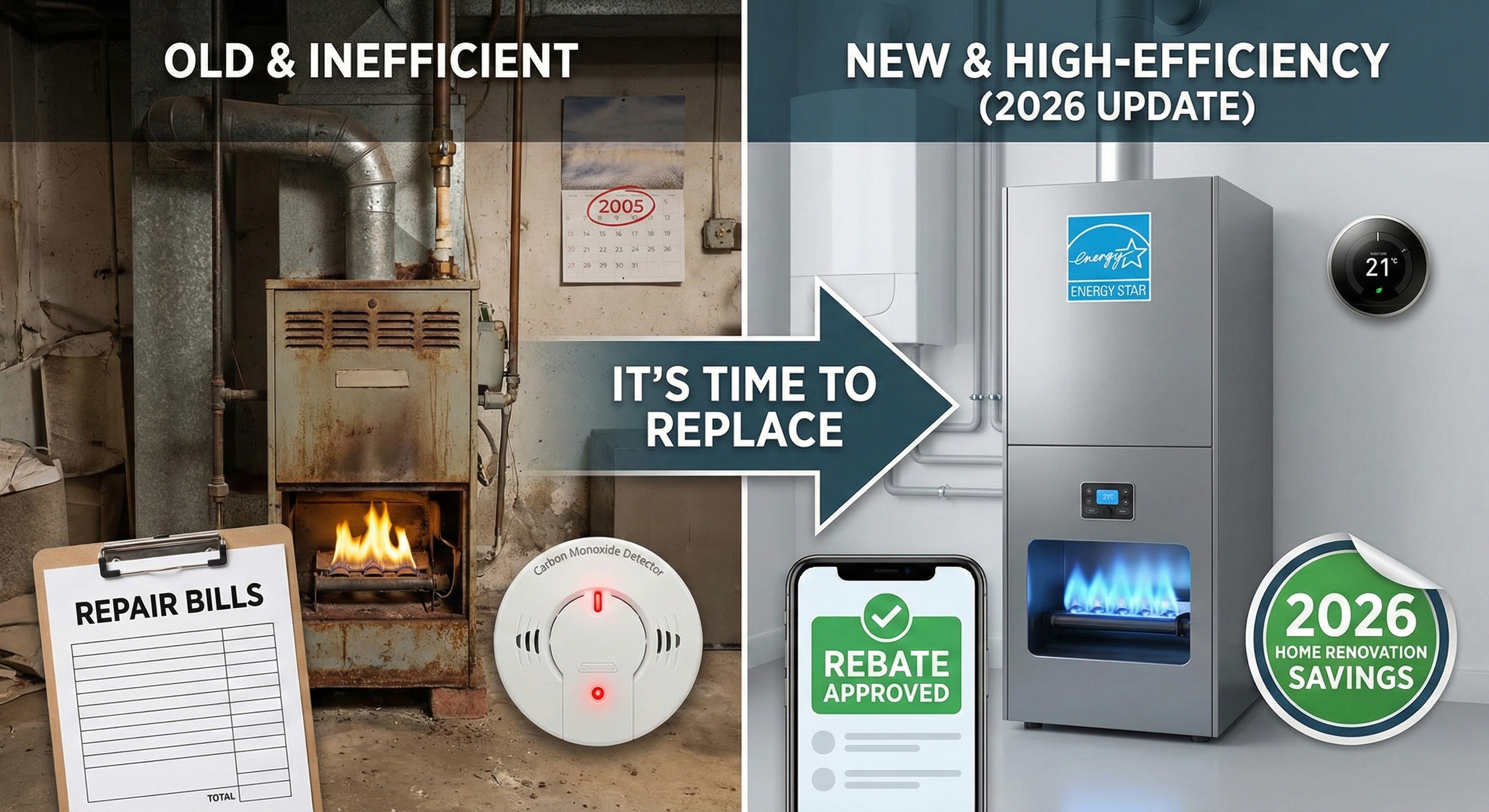
Old Efficiency: A furnace from 2005 might have been rated at 80% AFUE (Annual Fuel Utilization Efficiency) when it was new. Today, due to wear, it might only be operating at 60-70% efficiency. That means for every dollar you spend on gas, 30 to 40 cents is literally going up the chimney.
New Efficiency: Modern Energy Star certified products must meet strict efficiency standards, often exceeding 95% to 98% AFUE.
Upgrading to a new high-efficiency Lennox or Carrier furnace can reduce your heating costs significantly. Over the 15-year life of the system, these energy savings can pay for a large portion of the installation cost.
4. You Have Hot and Cold Spots (Comfort Issues)
Does your upstairs bedroom feel like a sauna while your living room is freezing? Or perhaps you are constantly battling dry air in the winter and sticky humidity in the summer?
Inconsistent temperatures are often caused by:
A failing blower motor that can't push air to the far reaches of your ductwork.
An improperly sized unit (too big or too small for your home).
Cracked heat exchangers affecting airflow.
Modern HVAC systems offer variable-speed motors and two-stage heating, which run at lower speeds for longer periods. This gently mixes the air in your home, eliminating hot and cold spots. If your current system leaves you reaching for a sweater in one room and a fan in another, it’s time to upgrade your home comfort.
5. You Hear Strange Noises or Smell Odd Odours
Your furnace should be a silent partner in your home comfort. If it starts making its presence known with loud noises, it’s crying out for help.
Squealing/Screeching: Often a belt or motor bearing issue.
Banging/Clanking: Could indicate a broken or loose part inside the blower assembly.
Rattling: Often a sign of a cracked heat exchanger (a serious safety risk).
Smells are even more concerning. A "dusty" smell when you first turn the furnace on in October is normal. However, a persistent burning smell, a rotten egg smell (gas leak), or a chemical scent could indicate a cracked heat exchanger or electrical failure.
Safety Warning: If you smell gas, leave your home immediately and call Enbridge or 911. For other strange noises, call our 24/7 Emergency Service line at (519) 652-0416.
6. Carbon Monoxide & Safety Risks
Safety is the absolute most important reason to replace an aging system. The most critical component of a gas furnace is the heat exchanger, a metal chamber that separates the burning gas from the air you breathe.
Over years of expanding and contracting with heat, this metal can crack. A cracked heat exchanger allows deadly Carbon Monoxide (CO) to leak into your home’s air supply.
Yellow Flames: A healthy furnace flame should be blue. A yellow or flickering flame is a sign of incomplete combustion.
Excess Moisture: If you see condensation on your windows or water pooling around the furnace base, it could indicate venting issues.
According to the Technical Standards and Safety Authority (TSSA), carbon monoxide is known as the "silent killer" because it is colourless, odourless, and tasteless. If a technician "red-tags" your furnace due to a cracked heat exchanger, replacement is usually the only safe option to protect your family.
The Good News: 2026 Rebates & Financial Incentives
If you’ve nodded along to any of the signs above, you might be worried about the cost of replacement. The good news is that 2026 is an excellent year to upgrade thanks to new provincial incentives.
The Home Renovation Savings Program (HRS), available through Save on Energy, offers substantial rebates for Ontario homeowners who install energy-efficient equipment.
Heat Pumps: You could be eligible for significant rebates if you switch to a high-efficiency air-source or ground-source heat pump.
Smart Thermostats: Rebates are often available for installing qualifying smart thermostats that help you manage energy use.
At My Fireplace, we also offer flexible HVAC financing plans that allow you to install a new high-efficiency system for low weekly payments. You can start saving on your energy bills immediately without the stress of a large upfront payment.
Frequently Asked Questions
How do I know if my furnace heat exchanger is cracked? You cannot always see a crack with the naked eye. Common signs include a flickering yellow flame (instead of blue), soot buildup, excessive moisture on windows, or a Carbon Monoxide detector alarm. A cracked heat exchanger is a serious safety risk and requires immediate professional inspection.
Is it better to replace my AC and furnace at the same time? Yes. Replacing both units together ensures your system is "matched," meaning the blower motor and condenser coil are designed to work together for maximum efficiency. It also saves you money on labour costs compared to two separate installations.
What rebates are available for HVAC in 2026? Ontario homeowners can access rebates through the Home Renovation Savings Program (HRS) and federal Greener Homes initiatives. These cover upgrades like high-efficiency furnaces, air-source heat pumps, and smart thermostats. Contact My Fireplace to see which rebates apply to your specific home.
Can I finance a new HVAC system? Absolutely. My Fireplace offers flexible financing plans that allow you to install a new, energy-efficient system for low weekly payments. This lets you offset the cost of the unit with the immediate savings on your monthly energy bills.
Ready to Upgrade?
Don't wait for your furnace to quit on the coldest day of the year. Be proactive and schedule a free in-home consultation with our team. We have been serving London and St. Thomas for over 30 years, and our licensed technicians can help you find the perfect system for your home size and budget.
Your HVAC system works hard to keep your home comfortable throughout Ontario’s changing seasons. But like any appliance, it won’t last forever. Knowing when to repair versus when to replace can save you time, money, and stress in the long run. Here are some of the most common signs it’s time to consider a replacement—and how My Fireplace can help.
Lorem ipsum dolor sit amet, consectetur adipiscing elit. Suspendisse varius enim in eros elementum tristique. Duis cursus, mi quis viverra ornare, eros dolor interdum nulla, ut commodo diam libero vitae erat.
Lorem ipsum dolor sit amet, consectetur adipiscing elit. Suspendisse varius enim in eros elementum tristique. Duis cursus, mi quis viverra ornare, eros dolor interdum nulla, ut commodo diam libero vitae erat.